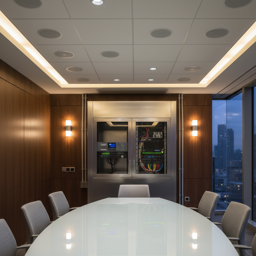
Walk into any thriving hotel lobby, corporate headquarters, or house of worship today, and you’ll encounter something that most visitors take entirely for granted: audio that simply works. No feedback squeal when the pastor grabs the mic. No dead zones in the back corner of the conference room. No patchwork of mismatched speakers producing uneven volume across a restaurant floor. What looks effortless is the product of a well-engineered commercial audio system — and in 2026, those systems have never been more capable, or more complex to specify correctly.
This guide is for facility managers, AV project managers, IT directors, and business owners who need to understand — or re-evaluate — the distributed audio infrastructure in their buildings. We’ll cover every layer of a commercial audio system, from DSP processors and amplifiers to ceiling speakers and Dante networking, and we’ll explain exactly why the choices you make in 2026 will either futureproof your investment or saddle you with an expensive upgrade cycle in three years.
Why Commercial Audio Systems Are Not What They Were Five Years Ago
The commercial AV industry crossed a critical threshold between 2023 and 2025: analog signal routing gave way to networked audio infrastructure, and proprietary DSP platforms started integrating machine learning at the chip level. As Commercial Integrator noted in their 2026 trends roundup, the smartest approach for facilities today is to invest in the fundamentals — rooms that capture clean audio and reliable video — because when AI takes its next leap, those environments will be ready without a hardware rip-and-replace.
Three forces are reshaping how commercial audio is designed and deployed right now:
- AI-assisted signal processing: Platforms like Biamp’s Tesira with Parlé ceiling microphones now use beam-steering algorithms to track speakers and suppress noise in real time — automatically, without a programmer tuning gain structure by hand.
- AoIP (Audio over IP) standardization: Dante has become the de-facto standard for professional audio networking, allowing audio signals to travel over standard IT infrastructure. Shure, QSC, Biamp, and virtually every tier-1 manufacturer now ship Dante-enabled hardware as default.
- Platform convergence: QSC’s January 2026 launch of expanded Q-SYS Full Stack AV solutions — standardizing collaboration spaces while strengthening hospitality and entertainment applications — signals a clear industry move toward unified control environments where audio, video, and control exist in one ecosystem rather than three separate systems bolted together.
Understanding these forces is the starting point for any commercial audio spec written in 2026.
The Core Components of a Commercial Audio System
Regardless of application — corporate campus, retail chain, stadium concourse — every commercial audio system shares the same fundamental architecture. Let’s break it down layer by layer.
1. Sources and Inputs
Sources are everything that feeds audio into your system: wired microphones, wireless mic systems, streaming audio players, paging stations, emergency alert systems, AV over IP decoders, and conference room endpoints. The signal chain begins here, and the quality of your inputs will determine the ceiling of your entire system’s performance.
In 2026, most commercial installations favor a combination of wired boundary mics or ceiling array microphones (for conference and huddle rooms) and digital wireless systems (for presentation and theatrical applications). Shure’s MXA Series ceiling and table array microphones have become near-standard in enterprise meeting rooms, while Sennheiser’s Evolution Wireless Digital (EW-D) platform continues to dominate touring and fixed-install wireless applications.
2. Digital Signal Processor (DSP)
The DSP is the brain of your commercial audio system. It handles signal routing, mixing, equalization, dynamics processing (compression and limiting), delay compensation, and feedback suppression. Without a properly configured DSP, even the best speakers and amplifiers will underperform.
The three platforms that dominate commercial AV installations globally are:
- QSC Q-SYS: A software-defined platform that runs on dedicated Core processors. Q-SYS integrates audio processing, video routing, and system control in a single architecture. QSC’s new no-code, web-based room deployment platform (announced at ISE 2026) allows configurations to be built and adjusted without traditional programming — a significant step toward simplifying deployment for organizations without dedicated AV engineers.
- Biamp Tesira: Biamp’s flagship DSP platform, widely used in large enterprise, higher education, and government facilities. The Tesira platform supports Dante, AES67, and AVB networking, and pairs with Biamp’s Parlé ceiling microphone array for intelligent beam-steering.
- Extron DMP Series: Common in education and smaller corporate applications, Extron’s DSP processors are known for their integration with Extron control systems and their straightforward programming interface.
For smaller installations — a single boardroom, a retail environment, a restaurant — self-contained DSP amplifiers from Soundcraft, Ashly Audio, or Crown (a Harman brand) can handle signal processing and amplification in a single chassis, reducing rack footprint and installation complexity.
3. Amplifiers
Commercial audio amplifiers come in two principal flavors: low-impedance (4–16 ohm) and 70-volt / 100-volt distributed. The choice between these architectures is one of the most consequential decisions in a commercial audio design, and it’s governed by the size of the facility and the number of speakers being driven.
Low-impedance systems are used for high-fidelity applications where audio quality is paramount: concert venues, boardrooms, lecture halls, and broadcast control rooms. They require individual runs of speaker cable from the amplifier to each speaker (or to each cluster in multi-cabinet configurations). The wiring complexity and cost scale quickly with large installations.
70-volt (70V) distributed systems are the workhorse of commercial audio — used in virtually every restaurant, retail store, hotel, office building, and educational campus where background music, paging, or ambient audio is required across many zones. In a 70V system, a step-up transformer at the amplifier output boosts the signal to 70.7 volts, and a matching transformer tap on each speaker steps the voltage back down to drive the speaker directly. The key advantage: many speakers can be connected in parallel on a single cable run without impedance issues, dramatically simplifying large-scale installations.
As Crutchfield’s commercial audio introduction explains, 70V systems are often the best solution for commercial and institutional buildings precisely because they allow the low-voltage installer to wire a 40-speaker retail floor with the same infrastructure complexity as a 10-speaker installation.
4. Speakers
Commercial speaker selection involves far more variables than residential audio. Ceiling height, room acoustics, background noise level, coverage pattern requirements, weather exposure (for outdoor zones), and aesthetic constraints all influence which speaker type is appropriate for a given space.
The most common commercial speaker categories:
- In-ceiling speakers (round or square, 70V or 8-ohm): The default choice for background music and paging in offices, retail, hospitality, and healthcare environments. Key brands: JBL Professional, Bose Professional, Atlas Sound, TOA.
- Surface-mount (pendant / pendant ball) speakers: Used in spaces where in-ceiling installation is impractical (concrete decks, industrial environments, outdoor patios). The JBL Control 400 Series — reviewed recently on this blog — exemplifies this category at its current commercial standard.
- Line array systems: For large venues, houses of worship, and auditoriums where controlled throw and consistent SPL across a long throw distance are required. Leading manufacturers include Martin Audio, d&b audiotechnik, and L-Acoustics.
- Column array / architectural speakers: Slim-profile speakers designed for aesthetically sensitive environments (museums, boardrooms, hospitality venues) while maintaining intelligible speech coverage. Genelec and AUDAC have strong offerings in this category.
Designing a Commercial Audio System: The Planning Process
The difference between a commercial audio system that performs flawlessly and one that generates service calls for years comes down almost entirely to the design process. Here’s how a professional AV integrator approaches a new installation.
Step 1: Acoustic Assessment
Before a single piece of equipment is specified, an experienced integrator or acoustical consultant will evaluate the space. Key measurements include:
- Ambient noise floor: The baseline SPL (in dB-A) of the space with its normal HVAC, traffic, and operational noise present. This determines how loud your system needs to be to achieve intelligible speech.
- Room dimensions and ceiling height: Governs speaker placement grid, required wattage per zone, and whether point-source or distributed coverage is more appropriate.
- Reverberation time (RT60): In highly reverberant spaces (concrete floors, glass walls, high ceilings), intelligibility suffers dramatically. DSP delay compensation and directional speaker patterns become critical in these environments.
- Construction type: Plenum-rated spaces (above drop ceilings used as HVAC return paths) require plenum-rated (CMP) speaker wire to meet fire safety codes — a detail that catches uninformed installers regularly.
Step 2: Zone Architecture Design
Commercial audio systems are almost always multi-zone — different areas of a building require independent audio control. A hotel needs different programming (and volume levels) in the lobby, the restaurant, the fitness center, the pool area, and the conference rooms. A corporate campus needs each floor’s open office area to operate independently, with conference rooms and the cafeteria on their own zones.
Zone architecture drives rack design, DSP channel count, amplifier selection, and cabling topology. In a modern installation, zones are configured as software-defined entities within the DSP — meaning zones can be added, merged, or reassigned without any hardware changes after the system is built.
Step 3: Speaker Placement Using Acoustic Modeling
For anything beyond a simple 4-speaker retail installation, professional integrators use acoustic modeling software — CATT-Acoustic, EASE, or manufacturer-provided prediction tools — to map speaker coverage before committing to a cable layout. As AV Specialists notes in their installation guide, integrators use CAD drawings combined with SPL predictions to ensure even coverage (within ±3 dB across the listening plane) before a single hole is cut in a ceiling tile.
Step 4: Infrastructure and Cabling
In a Dante-networked audio installation, the cabling plant is primarily standard Cat6 or Cat6A Ethernet — the same infrastructure your IT team manages. This convergence of AV and IT infrastructure is accelerating in enterprise environments because it eliminates the need for dedicated audio multicable runs and allows audio to be rerouted via software without physical recabling.
For traditional 70V installations, speaker wire gauge matters: longer runs to high-wattage taps require heavier gauge wire (typically 14 AWG to 12 AWG) to prevent resistive signal loss. Installations in plenum spaces require CMP-rated cable throughout — no exceptions.
Step 5: DSP Programming and System Commissioning
Once hardware is installed and cabling is terminated, the DSP programmer configures the system logic: routing, EQ curves, compression thresholds, delay times, preset scenes, and control system integration. This programming phase is where the investment in a high-quality DSP platform pays off — a well-built Q-SYS or Biamp program can be updated remotely, can respond to control system triggers, and can be handed off to a facility manager with a clean, simplified user interface.
Commissioning includes walking every zone with a calibrated measurement microphone, trimming levels, and validating that intelligibility scores (often measured as STI — Speech Transmission Index) meet the project specification. For life-safety paging systems, NFPA 72 compliance requires documented STI measurements above 0.45 in all occupied areas.
Commercial Audio for Specific Environments in 2026
Corporate Offices and Conference Rooms
The post-pandemic hybrid work environment has made conference room audio the single most scrutinized application in commercial AV. According to enterprise AV consultants at VIcom, the 2026 enterprise standard for medium conference rooms (6–12 seats) specifies ceiling array microphones (Shure MXA910 or Biamp Parlé), with DSP-based audio from QSC or Biamp in larger boardrooms. The Nureva HDX Series — expected to reach market in summer 2026 — pairs Microphone Mist technology with AI noise suppression for Microsoft Copilot and Zoom AI Companion integration, signaling the next generation of intelligent conference room audio.
For ambient background music and paging across open office floors, a 70V distributed system with ceiling speakers remains the standard — but the control layer has evolved. Most enterprise deployments now use app-based zone control (Crestron, QSC, Biamp) accessible from mobile devices, allowing facilities managers to adjust volumes, switch sources, or mute zones without touching a physical panel.
Hospitality: Hotels, Restaurants, Bars, and Resorts
Hospitality audio is a revenue-impacting discipline. Research consistently shows that music tempo, volume, and genre influence dwell time, average check size, and customer satisfaction scores. A properly designed hotel restaurant audio system isn’t just background noise — it’s a brand experience tool.
The design challenge in hospitality is handling multiple zones with wildly different acoustic characters simultaneously: a reverberant atrium lobby, an intimate bar with acoustic tile, an outdoor pool deck with ambient wind noise, and private dining rooms with variable occupancy. This is exactly the application QSC’s 2026 platform expansion targets, with native hospitality and entertainment applications built into Q-SYS to manage multi-zone scheduling, volume automation based on time-of-day, and integration with streaming music services like Soundtrack Your Brand or Cloud Cover Music (both commercially licensed platforms, unlike consumer Spotify).
Houses of Worship
Houses of worship represent one of the most acoustically demanding commercial audio applications. Large sanctuaries often have RT60 values above 2 seconds, high ceilings with complex geometry, and a requirement for exceptional speech intelligibility across a full range of service formats — from quiet spoken word to full band reinforcement.
Line array systems (flown or ground-stacked) from L-Acoustics, Yamaha Commercial Audio, or Martin Audio are increasingly common in mid-to-large sanctuaries, replacing the distributed ceiling speaker systems of previous generations. Digital mixing consoles from Yamaha CL Series, Allen & Heath, and Avid have become accessible enough for mid-market houses of worship to afford.
Healthcare and Education
In healthcare, commercial audio systems must satisfy both functional and regulatory requirements. Mass notification and emergency paging systems in hospitals must comply with NFPA 72 and Joint Commission standards, requiring documented intelligibility testing and battery backup infrastructure. Background music in patient care areas follows evidence-based design guidelines linking acoustic environments to patient outcomes.
In K-12 and higher education, the shift to active learning classrooms and hybrid lecture formats has driven demand for high-quality room audio that works equally well for in-room students and remote participants. This is one of the key design challenges explored in our post on Designing Audio Systems for Large Commercial Spaces — which covers the project management and documentation workflow for complex educational installations in detail.
Understanding Commercial Audio System Costs in 2026
Cost is always context-dependent, but these ranges provide a useful baseline for commercial audio installations in 2026:
| Application Type | Rough Cost Range | Notes |
|---|---|---|
| Small retail (under 3,000 sq ft) | $3,000–$8,000 | 4–8 ceiling speakers, basic DSP mixer, single zone |
| Restaurant / bar (3,000–6,000 sq ft) | $8,000–$25,000 | Multi-zone, 70V distributed, integration with POS/DJ input |
| Corporate office floor | $15,000–$60,000 | Multi-zone paging + background music + 4–8 conference rooms |
| Boardroom / executive conference | $25,000–$80,000+ | DSP, ceiling arrays, integrated AV control, video conferencing |
| Hotel (full property) | $100,000–$500,000+ | Lobby, F&B outlets, pool, conference center, guestrooms |
| House of worship (mid-size) | $50,000–$200,000 | Sanctuary main system + lobby + overflow rooms |
These figures cover equipment and installation labor. They do not include ongoing commercial music licensing (required for any business playing background music — see ASCAP and BMI), annual service agreements, or the software subscription costs of cloud-managed platforms.
The AoIP Revolution: Why Dante Matters for Your Next Installation
Audio over IP (AoIP) deserves its own section because it fundamentally changes how commercial audio systems are designed, installed, and maintained. Dante by Audinate is the dominant AoIP protocol in professional audio — it’s implemented by over 600 manufacturers in more than 4,000 products.
In a Dante-enabled installation:
- Audio signals travel as data packets over standard Gigabit Ethernet infrastructure
- Any Dante device on the network can send audio to any other Dante device — in any quantity, in any direction, without physical patching
- Routing changes happen in software (Dante Controller) in seconds, with no down-time
- Latency is typically under 1 millisecond on a properly configured network
- The system scales from 2 devices to thousands without architectural changes
For enterprise facilities with dedicated IT teams, Dante’s integration with managed network switches (QoS configuration, VLAN separation) is well-documented and understood. For smaller installations, Dante devices can operate plug-and-play on a flat network. The practical result: an organization’s audio infrastructure is no longer physically constrained by how much multi-pair audio cable was run during original construction.
This is particularly significant for retrofit installations in existing buildings — a challenge that, as we noted in our overview of The State of Commercial AV in 2026, is one of the industry’s fastest-growing segments as pre-pandemic office buildouts are refreshed for hybrid work.
Choosing the Right Commercial Audio Integrator
A well-designed commercial audio system can last 15–20 years with proper maintenance. A poorly designed one generates service calls, creates staff frustration, and often gets partially replaced within five years. The quality of your integrator is arguably more important than the brand of equipment specified.
When evaluating an AV integrator for a commercial audio project, look for:
- AVIXA CTS certification: The Certified Technology Specialist (CTS) credential from AVIXA is the industry’s baseline professional certification. CTS-D (Design) and CTS-I (Installation) specializations indicate deeper technical competency.
- Manufacturer training certifications: QSC Q-SYS Level 1/2, Biamp Tesira certification, Crestron DMC-D or DMC-E certifications indicate that technicians have completed formal platform training — not just watched a YouTube tutorial.
- Design documentation deliverables: A professional integrator should provide a full AV drawing package — system schematics, rack elevation drawings, zone maps, and DSP programming documentation — not just a verbal proposal and a quote.
- References from comparable projects: Ask for references from projects with similar scope: comparable square footage, similar zone count, same application type.
- Service contract options: Remote monitoring, annual preventive maintenance, and response time SLAs are the mark of an integrator who intends to stand behind their work long-term.
AVIXA’s Find an Integrator tool allows facility managers to search for certified integrators by location and specialty — a useful starting point for any RFP process.
What to Expect From Commercial Audio in 2027 and Beyond
The commercial audio industry is moving faster than it has at any point in the past two decades. Based on current trajectories, here’s what facility managers and AV integrators should be planning for:
- AI-native DSP: The next generation of DSP platforms will incorporate on-device AI models for real-time acoustic adaptation — systems that listen to a room and continuously adjust EQ, delay, and gain based on occupancy, furniture arrangement, and even weather (which affects outdoor system acoustics).
- Zero-programming deployment: QSC’s ISE 2026 announcement of a no-code web-based deployment platform is the beginning of a broader industry shift toward template-driven system deployment. Expect deployment times for standard room types to drop from days to hours.
- Wireless infrastructure maturity: CES 2026 previewed wireless-ready commercial speaker systems with app-based tuning that are increasingly viable for retrofit installations. By 2027–2028, the performance gap between wired and wireless commercial audio infrastructure will be negligible for background music applications.
- Integration with building automation: Audio systems will increasingly operate as nodes within broader building intelligence platforms — automatically muting zones when HVAC maintenance is triggered, adjusting background music tempo during peak retail hours based on foot traffic data, or switching to emergency override when fire alarm inputs are detected.
Frequently Asked Questions
What is the difference between a 70V and an 8-ohm commercial audio system?
A 70-volt system uses a step-up transformer to boost the amplifier output to 70.7V, allowing many speakers to be connected in parallel on a single cable run without impedance loading issues. It’s ideal for large distributed audio installations (restaurants, retail, offices) where many speakers cover a large area from a central rack. An 8-ohm (low-impedance) system connects speakers directly without transformer taps, delivering higher audio fidelity but requiring individual cable runs to each speaker or speaker cluster — better suited for high-quality applications like conference rooms, performance venues, and boardrooms.
How many ceiling speakers do I need per square foot?
A general rule of thumb for background music with standard 8-inch ceiling speakers (approximately 90° coverage angle) in a ceiling height of 9–10 feet is one speaker per 100–150 square feet of coverage area. However, this varies significantly based on ambient noise level, ceiling height, room geometry, and required SPL. An acoustic analysis by a qualified integrator will produce a coverage map far more accurate than any rule-of-thumb calculation.
Do I need a commercial music license to play background music in my business?
Yes. Playing music in a business (whether from a streaming service, radio, CDs, or any other source) for customers or employees requires a public performance license. In the United States, this means licensing from the three major PROs: ASCAP, BMI, and SESAC. Commercial music services like Soundtrack Your Brand, Cloud Cover Music, and PlayNetwork handle licensing on your behalf as part of their subscription fee, which is why they’re recommended over consumer streaming platforms for business use.
What is Dante and why does it matter?
Dante is an Audio over IP (AoIP) networking protocol developed by Audinate that allows professional audio devices to send and receive audio over standard Ethernet infrastructure. It’s now supported by over 600 manufacturers and is the de-facto standard for professional audio networking. In practical terms, it means your commercial audio system can route audio between any two Dante-enabled devices in the building via the IT network, without running additional audio cable — dramatically simplifying installation in large or multi-floor facilities.
Building Your Commercial Audio System: The Bottom Line
A commercial audio system is a long-term infrastructure investment. Done right, it enhances every person who walks into your building — customers who stay longer, employees who perform better, conference participants who can actually hear what’s being said. Done wrong, it becomes a persistent liability that undermines the credibility of everything else in your AV stack.
The 2026 market offers exceptional tools at every price point — from self-contained DSP amplifiers for small retail to full Q-SYS or Biamp ecosystems for enterprise campuses. The discipline of designing and deploying these systems correctly hasn’t changed: assess the acoustics, design the zones, model the coverage, specify the infrastructure, commission with measurements. What has changed is that the platforms now do more of the heavy lifting — AI noise suppression, AoIP routing, app-based control — freeing integrators and facility managers to focus on the outcomes rather than the mechanics.
If you’re evaluating a new audio installation or upgrading an existing one, start with a qualified integrator who holds AVIXA credentials and has documented experience with your application type. And if you want to dig deeper into specific components — ceiling speakers, DSP platforms, wireless systems — the resources on this blog will walk you through the options in detail. Check out our JBL Control 400 Series review for a deep dive into one of the most capable commercial ceiling speaker systems currently on the market.
Have questions about specifying a commercial audio system for your facility? Drop them in the comments below, or reach out to a certified AV integrator through AVIXA’s directory.
