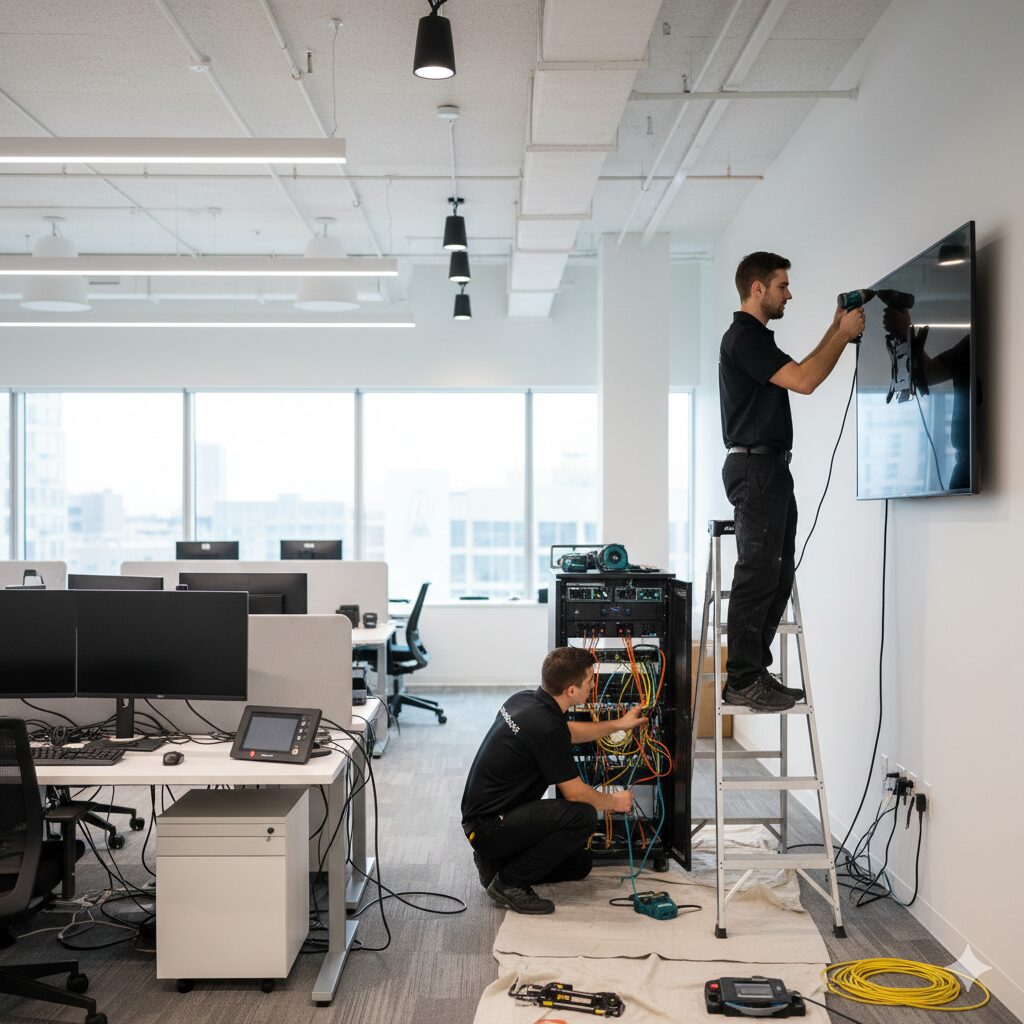

Companies Shaping the Future of Commercial AV
TL;DR
- The AV integration industry continues to evolve rapidly, with specialized firms carving out niches in hospitality, experiential design, corporate collaboration, and broadcast
- Finding the right integrator means matching their specialty to your project type—a sports bar has different needs than a corporate headquarters
- This list highlights eight integrators doing notable work across different verticals, from immersive attractions to multi-location restaurant deployments
- Size isn’t everything: mid-market integrators often deliver more personalized service and faster response times than industry giants
- Consider an integrator’s recent project portfolio, vertical expertise, and geographic footprint when evaluating potential partners
Why “Integrators to Watch” Matters for Your Next Project
When you’re planning a significant AV investment—whether it’s a new conference center, a restaurant buildout, or a corporate campus refresh—the integrator you choose matters as much as the technology itself. The same equipment can deliver wildly different results depending on who designs, installs, and supports it.
The commercial AV industry is dominated by a handful of billion-dollar players like AVI-SPL and Diversified. These giants handle everything from Fortune 500 headquarters to government contracts. But the most interesting work often happens at firms that have developed deep expertise in specific verticals or technologies.
This isn’t a ranked list. Instead, we’ve identified eight integrators doing noteworthy work heading into 2026—companies whose recent projects, growth trajectory, or specialized capabilities make them worth knowing about. Whether you’re a restaurant operator, corporate facilities manager, or hospitality developer, there’s likely a firm here that aligns with your needs.
Integrators Making Moves in 2026
Crunchy Tech
Headquarters: Orlando, Florida
Founded: 2008
Primary Verticals: Hospitality, Sports Bars, Restaurants, Corporate, Retail
Geographic Reach: National
Why They’re on the List:
Crunchy Tech has built a reputation for transforming hospitality venues into immersive viewing destinations. Their work with Tom’s Watch Bar—a growing chain of sports-viewing destinations—demonstrates their ability to execute complex, multi-display environments at scale.
The Tom’s Watch Bar Orlando project alone required 124 TVs across indoor and outdoor spaces, 9 projectors, an integrated AV-over-IP system, and 5.6 miles of low-voltage wiring. That’s not a typo—five and a half miles of cable in a single venue. Crunchy Tech has delivered similar installations for the chain’s locations in Washington D.C., Houston, Sacramento, and Pittsburgh.
What Sets Them Apart:
For restaurant and bar operators, Crunchy Tech offers something increasingly valuable: experience with the specific challenges of hospitality AV. That means understanding how systems need to perform during a packed Saturday night, how to zone audio so the dining area doesn’t compete with the bar, and how to design control systems that bartenders and managers can actually operate without calling for support.
Their full-service model covers consultation, design, installation, and ongoing support—important for multi-location operators who need consistency across venues. They also operate an online sales portal for clients who know what they need and want to purchase equipment directly.
Best Fit For: Sports bars, restaurants, entertainment venues, and hospitality operators looking for immersive guest experiences with complex multi-display and audio zoning requirements.
Electrosonic
Headquarters: Orlando, Florida (relocated 2022)
Founded: 1964
Primary Verticals: Theme Parks, Museums, Attractions, Corporate Experience Centers, Airports
Geographic Reach: Global
Why They’re on the List:
Electrosonic has been in the experiential technology business for six decades, but their recent work demonstrates they’re still pushing boundaries. Their View Boston project—a 59,000-square-foot observation deck at the Prudential Center—won the 2024 AV Award for Entertainment and Recreation Project of the Year, along with Commercial Integrator’s “Immersive Experience of the Year” recognition.
The project included experiential elevators with 14 LED screens creating a “through the clouds” journey, a 50-foot-wide 3D city model with synchronized projection mapping from 31 projectors, and a 270-degree theater with 18K resolution content. This is the kind of technology that was once reserved for major theme parks now being deployed in commercial attractions.
What Sets Them Apart:
Electrosonic operates at the intersection of AV integration and experience design. They don’t just install technology—they partner with architects, content creators, and designers to develop cohesive experiential environments. Their 2023 AV Award for Orlando International Airport’s experiential technology solutions shows they can apply this approach to practical commercial environments, not just attractions.
Their recent partnership with HOLOPLOT for immersive audio solutions signals continued investment in next-generation spatial sound capabilities.
Best Fit For: Museums, theme parks, visitor attractions, corporate experience centers, airports, and any organization looking to create destination-worthy immersive experiences.
Ford AV
Headquarters: Oklahoma City, Oklahoma
Founded: 1973
Primary Verticals: Corporate, Entertainment, Convention Centers, Higher Education
Geographic Reach: National (Enterprise-level)
Why They’re on the List:
Ford AV earned Commercial Integrator’s 2024 Best Corporate Space award for their work on Capital One’s BLOCK A—a 30-story building in McLean, Virginia, with AV infrastructure spanning 20 floors and 338 rooms. That’s enterprise-scale integration at its most demanding.
The project required sophisticated audio splitting and management for divisible conference rooms, partition sensors that automatically adjust audio zones when rooms are divided, and control interfaces simple enough for everyday users to operate without training.
What Sets Them Apart:
Ford AV is a family-founded company that’s been in business for over 50 years—a rarity in an industry marked by constant acquisition and consolidation. They were named Commercial Integrator’s 2018 Integrator of the Year, with founder Jim Ford’s involvement in AVIXA (formerly InfoComm) leadership shaping their approach to the industry.
Their strength is executing on large-scale corporate projects where reliability and consistency across hundreds of rooms is non-negotiable. SCN’s 2024 Top 50 report noted Ford AV among the integrators showing revenue growth in a challenging year.
Best Fit For: Large corporate campuses, convention centers, higher education institutions, and entertainment venues requiring enterprise-scale integration with long-term reliability.
Level 3 Audiovisual
Headquarters: Arizona
Founded: 2014
Primary Verticals: Corporate, Intelligent Spaces, IoT Integration
Geographic Reach: Global (via PSNI Alliance)
Why They’re on the List:
Level 3 Audiovisual ranked #37 on SCN’s 2024 Top 50 Integrators list, up from #44 in 2023. More notably, 2024 marked their tenth consecutive year on the list—remarkable for a company that started with one employee working from a spare bedroom.
Their focus on “intelligent spaces” positions them at the intersection of AV and IoT, where conference rooms, collaboration spaces, and building systems all communicate and adapt to user needs.
What Sets Them Apart:
Level 3’s AV9000 quality management program ensures standardized project execution, reducing the variability that plagues many AV installations. As a Certified Solution Provider of the PSNI Global Alliance, they can serve clients with multiple locations worldwide through a network of trusted partners in over 200 economic centers.
For corporate clients with global footprints, this means one point of contact coordinating installations across different countries with consistent quality standards—something even much larger integrators struggle to deliver.
Best Fit For: Corporate clients with multiple locations, organizations investing in smart building technology, and companies looking for consistent global service with local execution.
Data Projections
Headquarters: Houston, Texas
Founded: 1987
Primary Verticals: Corporate, Higher Education, Healthcare
Geographic Reach: Texas (Austin, Dallas, Houston, Lubbock, San Antonio)
Why They’re on the List:
Data Projections has maintained a consistent presence on SCN’s Top 50 list by focusing on depth rather than breadth. Their geographic concentration in Texas allows them to deliver responsive local service across the state’s major metropolitan areas.
Their approach—helping clients “connect with others, collaborate in innovative ways and simplify even the most technically complex processes”—reflects a focus on practical outcomes rather than technology for its own sake.
What Sets Them Apart:
Regional integrators like Data Projections often deliver advantages that national players struggle to match: faster response times, deeper relationships with local contractors and IT teams, and genuine accountability when problems arise. For Texas-based organizations, having five offices across the state means same-day service is realistic rather than aspirational.
Their longevity—37 years in business—provides the institutional knowledge to understand how technology decisions made today will play out over time.
Best Fit For: Texas-based corporations, universities, and healthcare organizations looking for a regional partner with national-caliber capabilities.
Key Code Media
Headquarters: Moorestown, New Jersey
Founded: 1995
Primary Verticals: Broadcast, Higher Education, Sports Venues, Houses of Worship, Government
Geographic Reach: National
Why They’re on the List:
Key Code Media earned their fifth consecutive spot on SCN’s 2024 Top 50 list by successfully bridging multiple verticals: broadcast, post-production, and commercial AV. This cross-pollination gives them unique perspective on content creation and distribution that pure AV integrators often lack.
Their client roster spans from newsrooms and sports stadiums to classrooms and government facilities—environments where reliable video production and distribution are mission-critical.
What Sets Them Apart:
The broadcast heritage shows in their approach to commercial projects. When Key Code Media designs a stadium control room or university lecture capture system, they’re drawing on professional production workflows that prioritize reliability and operator efficiency.
Their growth in 2024 came specifically from focusing on customer pain points and delivering solutions that address real operational challenges rather than simply selling technology.
Best Fit For: Organizations with video production needs, sports venues, universities with lecture capture requirements, houses of worship, and government facilities.
USIS AV
Headquarters: Pearl River, New York
Founded: 2012
Primary Verticals: Corporate, Enterprise, Financial Services
Geographic Reach: National (Global through USIS parent company)
Why They’re on the List:
USIS AV has appeared on SCN’s Top 50 list every year since the company’s founding in 2012—twelve consecutive years of recognition. They work with recognizable brands, startups, and prominent enterprises on both routine and extraordinary AV projects.
As part of USIS, a global leader in technology enablement for the built environment, USIS AV has access to IT and security system capabilities that complement their core AV integration services.
What Sets Them Apart:
Their positioning as a “New York-based AV design/build and support firm” reflects a focus on the dense corporate environments of the Northeast, where space constraints, building codes, and high expectations create unique integration challenges.
The connection to USIS’s broader technology platform allows them to approach projects holistically, considering how AV systems interact with IT infrastructure, physical security, and building automation.
Best Fit For: Enterprise clients in the Northeast, financial services firms, and organizations looking for integrated AV, IT, and security solutions.
CTI (Collaborative Technology Innovations)
Headquarters: Various US locations
Primary Verticals: Corporate, Healthcare, Higher Education
Geographic Reach: National
Why They’re on the List:
CTI earned Commercial Integrator’s 2024 Integrator of the Year recognition—the industry’s highest honor for systems integration firms. This award reflects excellence across multiple dimensions: project quality, client satisfaction, business practices, and industry contribution.
What Sets Them Apart:
Integrator of the Year awards recognize companies that excel not just at installing equipment, but at operating sustainable, ethical businesses that advance the industry as a whole. CTI’s recognition suggests they’ve found the right balance between technical excellence and business fundamentals.
Best Fit For: Organizations seeking a proven partner with recognized industry leadership.
How to Choose the Right Integrator for Your Project
Knowing which integrators are doing interesting work is only the first step. Matching the right partner to your specific project requires evaluating several factors:
Match Vertical Expertise to Your Industry
An integrator with extensive restaurant experience will understand nuances that a corporate-focused firm might miss—things like how kitchen noise affects dining room audio, why outdoor displays need specific brightness ratings, or how control systems need to work when the manager has both hands full.
| If Your Project Is… | Look For Experience In… |
|---|---|
| Restaurant/Bar | Hospitality, entertainment, distributed audio |
| Corporate HQ | Enterprise AV, meeting rooms, collaboration technology |
| Retail | Digital signage, content management, loss prevention integration |
| Healthcare | Clinical environments, HIPAA considerations, nurse call integration |
| Museum/Attraction | Experiential design, immersive technology, content development partnerships |
Evaluate Geographic Fit
National integrators can serve any location, but response times and relationship depth vary. Consider:
- Where are their nearest service technicians?
- How do they handle after-hours emergencies?
- Do they have relationships with local electrical and IT contractors?
- For multi-location projects, can they provide consistent service across all sites?
Assess Recent Project Relevance
Ask for case studies from the past two years that match your project type and scale. AV technology evolves rapidly; experience from five years ago may not reflect current capabilities.
Check Certifications and Partnerships
AVIXA CTS certifications (CTS, CTS-D for design, CTS-I for installation) indicate investment in professional development. Manufacturer certifications (Crestron, Biamp, QSC, etc.) demonstrate expertise with specific technology platforms.
Understand the Service Model
The sale is just the beginning. Clarify:
- What’s included in the warranty period?
- What service level agreements (SLAs) are available?
- Who handles support calls—the integrator directly or a third party?
- What’s the typical response time for different issue severities?
The Bigger Picture: Industry Trends Shaping 2026
The integrators featured here are all navigating the same industry forces:
AV-over-IP continues its march. Traditional matrix switching is giving way to network-based video distribution, requiring integrators to strengthen their IT capabilities. Companies like Crunchy Tech’s use of AVoIP at Tom’s Watch Bar reflects this shift becoming standard practice.
Managed services are growing. Rather than just installing systems and walking away, integrators increasingly offer ongoing monitoring, maintenance, and management. This recurring revenue model benefits clients with predictable costs and proactive support.
Experiential expectations are rising. Electrosonic’s immersive attraction work influences corporate expectations. Today’s employee experience centers and customer briefing rooms need to compete with entertainment-quality experiences.
The workforce challenge persists. Skilled AV technicians remain in short supply, making integrator choice even more important. Companies with strong training programs and employee retention deliver more consistent results.
Conclusion: Your Next Steps
The best integrator for your project isn’t necessarily the biggest or the most awarded—it’s the one whose expertise, geography, and service model align with your specific needs.
For your next project:
- Define your requirements first. Before contacting integrators, document what you need the system to accomplish. (See our guide to writing an AV RFP for help with this.)
- Create a shortlist based on fit. Use the profiles above to identify 3-5 integrators whose vertical expertise and geographic coverage match your project.
- Request relevant case studies. Ask for examples of projects similar to yours in scope, industry, and timeline.
- Evaluate proposals beyond price. The lowest bid often isn’t the best value when you factor in service quality, response times, and long-term reliability.
- Check references thoroughly. Ask past clients specifically about how the integrator handled problems—because every project has them.
The commercial AV industry continues to evolve rapidly, with AI integration, sustainability requirements, and hybrid work demands creating new challenges and opportunities. The integrators who thrive in 2026 will be those who adapt to these changes while maintaining the fundamentals: quality design, reliable installation, and responsive support.
Have experience with these integrators or others we should know about? Drop us a note—we’re always looking for insights from the field.


