
Every January, the AV industry floods your inbox with predictions about game-changing technologies that will revolutionize your business. And every December, you’re left wondering why that ‘revolutionary’ solution still isn’t quite ready for prime time. Let’s cut through the noise together.
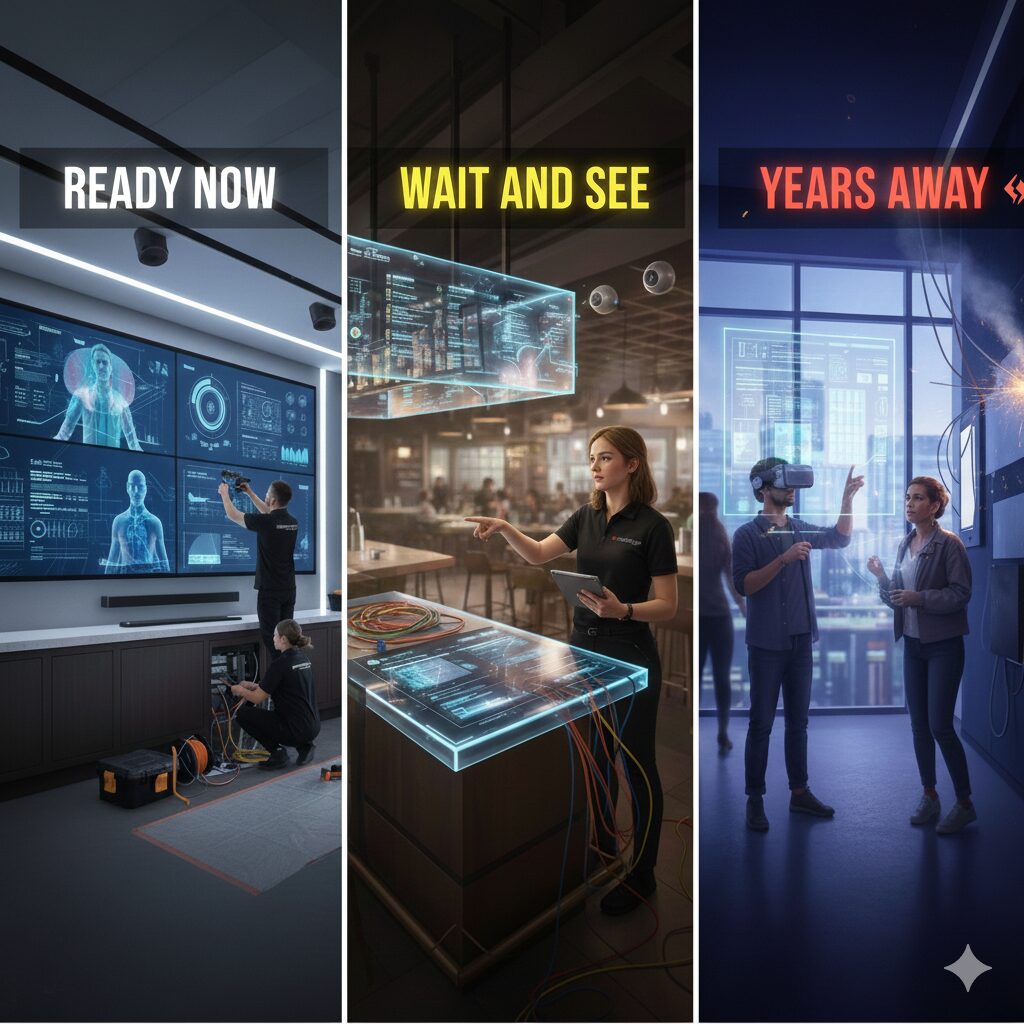
I’ve spent the last several months talking with integrators, attending trade shows, and—most importantly—watching what’s actually being deployed in restaurants, hotels, corporate offices, and retail spaces. Here’s my honest take on the commercial AV trends you’ll hear about in 2026, rated on a simple scale: Ready Now, Wait and See, or Years Away.
TL;DR
- Cloud-based AV control is genuinely ready for mainstream commercial deployment—stop waiting
- AI-driven content personalization works for digital signage today, but AI-generated video remains experimental
- MicroLED is spectacular but still priced for flagship installations only
- PoE lighting/AV convergence makes sense for new construction; retrofit ROI rarely pencils out
- Spatial audio and immersive experiences are exciting but need clearer commercial use cases
2026 Trend Readiness at a Glance
| Technology Trend | Readiness | Bottom Line |
|---|---|---|
| Cloud-Based AV Control | Ready Now | Mature, cost-effective, deploy with confidence |
| AI Content Personalization | Ready Now | Signage platforms already offer this |
| AI-Generated Video Content | Years Away | Quality and brand safety not there yet |
| MicroLED Displays | Wait and See | Premium only; prices dropping but slowly |
| PoE Lighting/AV Convergence | Wait and See | Great for new builds; retrofit rarely justified |
| Spatial/Immersive Audio | Wait and See | Niche applications; ROI unclear for most |
| Full AV-over-IP Infrastructure | Ready Now | Standard practice for mid-to-large installs |
Cloud-Based AV Control: Ready Now
Cloud-based control refers to managing your AV systems—displays, audio zones, lighting, HVAC integration—through internet-connected platforms rather than on-premise hardware. Think of it as the difference between running software on your own server versus using Google Workspace or Microsoft 365.
This technology has genuinely matured. Companies like QSC with Q-SYS, Crestron Home OS, and Utelogy have spent years hardening their cloud platforms, and the results show. I’ve seen restaurant groups managing 50+ locations from a single dashboard, pushing playlist updates, adjusting volume schedules, and troubleshooting problems without dispatching a single technician.
Why It’s Ready
The reliability concerns that plagued early cloud AV have largely been addressed. Modern systems cache locally, so your restaurant doesn’t go silent if the internet hiccups during a Saturday dinner rush. Remote diagnostics mean your integrator can often fix issues before you even notice them. And the subscription models—while an ongoing cost—eliminate those painful capital expenditure conversations.
The Business Case
A corporate client with 12 conference rooms recently told me their cloud control system paid for itself in eight months through reduced service calls alone. They went from averaging three technician visits monthly to about one every quarter. For multi-location businesses—franchise restaurants, hotel chains, retail stores—the centralized management capabilities transform how you operate.
Pro tip: When evaluating cloud platforms, ask specifically about offline functionality and data ownership. The best systems work seamlessly without internet and don’t hold your programming hostage in proprietary formats.
AI-Driven Content: A Tale of Two Technologies
“AI in AV” means wildly different things depending on who’s selling it to you. Let me break down what’s actually useful versus what’s still science fair material.
AI Content Personalization: Ready Now
AI content personalization uses machine learning to automatically select and schedule digital signage content based on factors like time of day, weather, audience demographics (via anonymous sensors), or sales data. This isn’t theoretical—platforms like Scala, BrightSign’s cloud CMS, and Navori already offer these capabilities.
A quick-service restaurant using AI-driven menu boards can automatically promote hot coffee when temperatures drop below 50°F, or push frozen drinks during heat waves. A retail store can shift promotional content based on real-time inventory levels. These aren’t future possibilities; they’re current deployments generating measurable ROI.
AI-Generated Video Content: Years Away
Now here’s where I’ll burst some bubbles. The demos showing AI generating custom video content for your screens are impressive—and largely impractical for commercial use today. The quality isn’t consistent enough for brand-conscious businesses, generation times are too slow for dynamic applications, and the “uncanny valley” effect can actually hurt your brand more than help it.
I’ve seen vendors pitch AI-generated spokesperson videos for hospitality lobbies. The technology is fascinating, but guest feedback has been consistently negative. People find synthetic humans unsettling, especially in hospitality contexts where warmth and authenticity matter. Give this 2-3 more years of development before serious commercial consideration.
MicroLED Displays: Wait and See
MicroLED refers to display technology using microscopic LEDs—typically under 100 micrometers—as individual pixels. Unlike traditional LED video walls that use LED packages containing multiple diodes, microLED puts tiny individual LEDs directly on the substrate. The result is stunning: perfect blacks, incredible brightness, wide viewing angles, and no burn-in risk.
The Reality Check
The technology is genuinely impressive—I’ve seen Samsung’s The Wall and Sony’s Crystal LED installations that made my jaw drop. But here’s what the trade show booths don’t emphasize: we’re still talking about $800-1,500 per square foot for quality microLED, compared to $200-400 for fine-pitch traditional LED.
For a 110-inch diagonal display, you’re looking at roughly $80,000-$120,000 for microLED versus $15,000-$25,000 for a comparable traditional LED or LCD video wall. That premium makes sense for luxury flagship locations where the “wow factor” drives revenue—think high-end auto dealerships, luxury hotel lobbies, or corporate headquarters reception areas.
When to Consider MicroLED
- Flagship retail locations where display quality directly impacts brand perception
- Corporate environments with direct-view applications at close distances (fine pixel pitch required)
- Installations where burn-in from static content is a genuine concern
- Projects with 5+ year timelines where you’re planning today for installation in 2027-2028
For most commercial applications, I’m advising clients to specify “microLED-ready” infrastructure—proper power, cooling, and mounting systems—while deploying current-generation technology. Prices are dropping roughly 15-20% annually, so the economics should look very different by 2027.
PoE Lighting/AV Convergence: Wait and See
Power over Ethernet (PoE) convergence refers to running lighting, AV equipment, sensors, and building controls over a single Category cable infrastructure. Instead of separate electrical runs for lights, data drops for network devices, and control wiring for building systems, everything travels over standardized Ethernet cables powered by PoE++ switches delivering up to 90W per port.
The New Construction Sweet Spot
For new construction, the value proposition is compelling. You’re running one cable type throughout the building, using IT staff (often more readily available) instead of specialized electricians for moves and changes, and gaining granular control over every device. A Class A office building I toured last year manages 3,000 PoE lighting fixtures, 200 occupancy sensors, and all conference room AV from a unified platform. Their energy savings alone justified the premium.
The Retrofit Reality
Here’s where I pump the brakes: retrofitting existing buildings for PoE convergence rarely makes financial sense. You’re replacing working lighting fixtures, pulling new cable runs (often the most expensive part of any low-voltage project), and upgrading network switches to handle the additional power load. I’ve seen retrofit quotes that would take 12+ years to achieve payback through energy savings.
My recommendation: If you’re building new or doing a gut renovation, absolutely explore PoE convergence. If you’re looking at incremental upgrades to existing facilities, focus your budget elsewhere.
Spatial and Immersive Audio: Wait and See
Spatial audio creates three-dimensional soundscapes where sounds appear to come from specific locations in space—above, below, around the listener—rather than just left, right, and center. Think Dolby Atmos in commercial applications: retail environments where sound follows you through the store, museums where audio guides seem to come from the artifacts themselves.
Where It Works Today
Experiential retail and entertainment venues are finding genuine success with spatial audio. I’ve visited immersive art installations where the audio component transformed a good experience into an unforgettable one. High-end theaters and performance venues are driving adoption, and the technology is mature for these applications.
The Commercial Question Mark
For typical commercial spaces—restaurants, corporate offices, retail stores—the ROI story gets murky. The speaker counts increase dramatically (you need height channels), installation complexity rises, and content creation costs multiply. Most importantly, the business outcome isn’t clear. Will spatial audio in your restaurant actually increase check averages or return visits? The data isn’t there yet.
My advice: unless you’re creating explicitly experiential environments where the audio is the attraction, traditional distributed audio systems remain the better investment for 2026.
Full AV-over-IP Infrastructure: Ready Now
AV-over-IP refers to distributing audio and video signals over standard network infrastructure rather than dedicated matrix switches and proprietary cabling. Standards like NDI, SDVoE, and Dante have matured to the point where this is no longer experimental—it’s becoming the default approach for mid-to-large installations.
Why It’s Genuinely Ready
The interoperability issues that plagued early AV-over-IP have largely been resolved. A corporate campus can now deploy displays from multiple manufacturers, all receiving content from shared encoders, switched by standard network equipment. Scalability is essentially unlimited—adding a new display means adding a decoder and a network drop, not replacing your entire matrix.
For a recent hospitality project—150 guest room TVs, 20 public displays, conference facilities—AV-over-IP came in at 30% less than a traditional HDBaseT matrix approach while offering far greater flexibility. The network infrastructure was already there; we just utilized it.
Infrastructure note: AV-over-IP does require proper network design—VLANs, QoS, adequate bandwidth. Partner with both your AV integrator and IT team from the start.
How to Evaluate Any AV Trend
Beyond these specific technologies, here’s the framework I use when clients ask about the latest trend they saw at InfoComm or read about in a trade publication:
Questions to Ask
- Who’s actually deploying this? Trade show demos don’t count. Ask for reference installations you can visit.
- What’s the total cost of ownership? Include installation, training, ongoing support, and content creation—not just hardware.
- What breaks? Every technology fails eventually. Understand failure modes and support availability.
- What’s the exit strategy? If the vendor disappears or the technology evolves, what happens to your investment?
- Where’s the measurable business outcome? “Improved guest experience” is not a metric. Increased dwell time, higher check averages, reduced service calls—those are metrics.
The Bottom Line for 2026
If you’re planning AV projects for the coming year, here’s where I’d focus your energy and budget:
Deploy Now with Confidence
- Cloud-based AV control for any multi-location or enterprise environment
- AI-powered content scheduling and personalization for digital signage
- AV-over-IP infrastructure for new installations and major renovations
Evaluate Carefully
- MicroLED for flagship locations with premium budgets
- PoE convergence for new construction only
- Spatial audio for explicitly experiential applications
Skip for Now
- AI-generated video content for customer-facing applications
- PoE convergence retrofits
- Any technology where the vendor can’t provide comparable reference installations
The AV industry will continue generating hype—that’s what trade shows are for. Your job is to filter signal from noise, and I hope this guide helps. Technology should solve business problems, not create new ones. When someone pitches you the next revolutionary AV trend, ask the simple question: who’s actually using this successfully today, and can I go see it?


