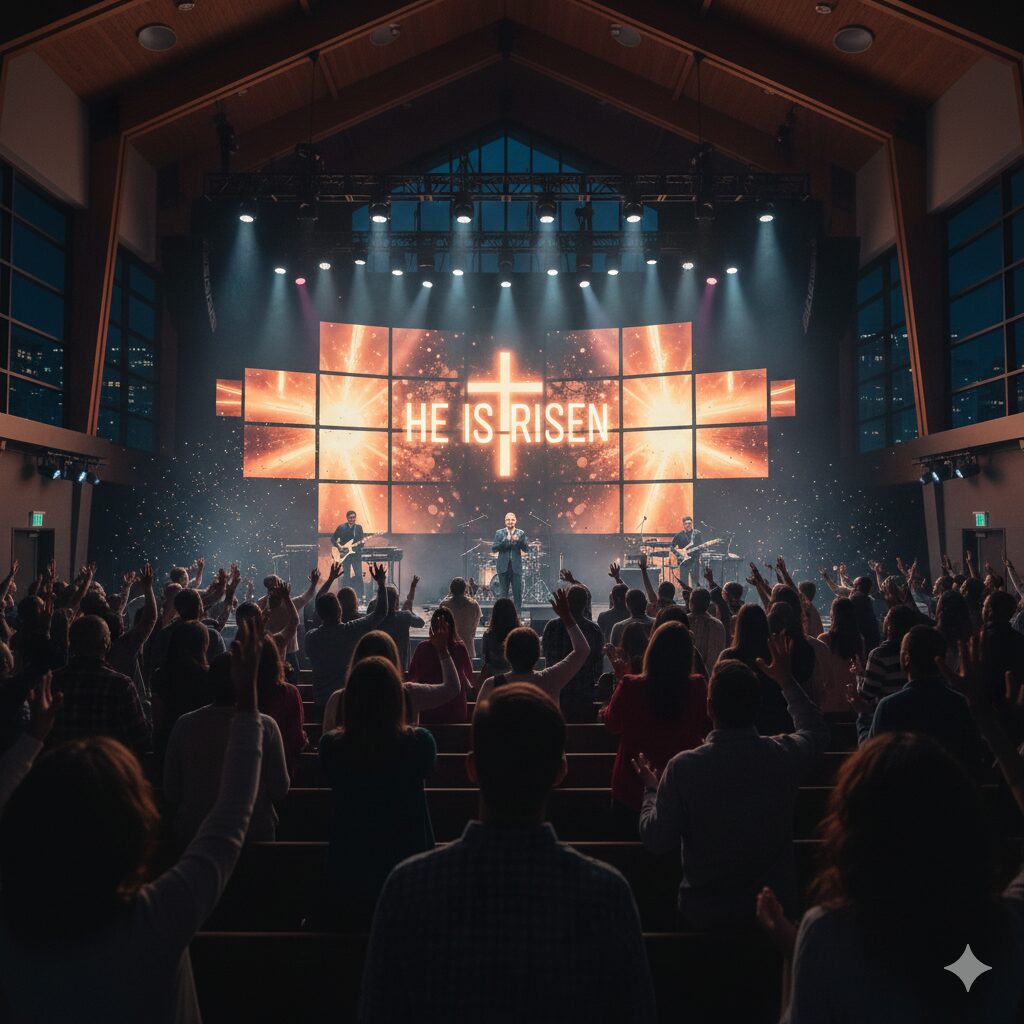

Easter Sunday is the biggest attendance day on your church calendar. Visitors who haven’t stepped inside a sanctuary in months—or years—will walk through your doors on April 5th, 2026. And whether you like it or not, your AV system shapes their experience: Can they hear the message clearly? Can they read the lyrics from the back row? Does the livestream look professional enough to share?
If your current AV setup has been limping along with workarounds and crossed fingers, Q1 is your window to fix it. But here’s what most church leaders discover too late: AV projects take longer than you think, and integrator calendars fill up fast.
This guide gives you the realistic timeline—and the practical steps—to get your worship technology Easter-ready.
TL;DR
- Easter 2026 is April 5th—work backward from there, and you’ll see why January decisions matter
- Most AV projects require 8-12 weeks from initial consultation to completed installation
- Quick-turnaround upgrades (wireless mics, streaming improvements) can happen in 4-6 weeks if you act by mid-February
- Larger projects like speaker systems or LED walls need decisions finalized by late January
- Budget conversations with church leadership go smoother when you frame AV as visitor experience and volunteer retention—not just “tech stuff”
Why the Timeline Matters More Than You Think
Here’s the timeline reality that catches most churches off guard: that “simple” AV upgrade involves more steps than just buying equipment and plugging it in.
A typical project flows through consultation, site assessment, system design, proposal review, board approval, equipment ordering, scheduling, installation, and training. Even when everything goes smoothly, you’re looking at 8-12 weeks. Add in a backlogged integrator, a supply chain delay, or a finance committee that meets monthly, and you’ve blown past Easter before the first cable gets pulled.
The math is unforgiving. If Easter falls on April 5th and you need a 10-week runway, your “go” decision needs to happen by late January. For complex projects, that means starting conversations now—not “after the new year settles down.”
The Reverse-Engineered Easter Timeline
Let’s work backward from Easter Sunday to see what needs to happen when:
| Milestone | Target Date | What’s Happening |
|---|---|---|
| Easter Sunday | April 5 | System fully operational, team trained |
| Final testing & training | March 22-29 | Volunteers learn the new system before Holy Week |
| Installation complete | March 15-21 | Buffer week for troubleshooting |
| Installation begins | March 1-14 | Integrator on-site |
| Equipment arrives | February 15-28 | Lead times vary; some gear takes 4-6 weeks |
| Proposal approved / PO issued | February 1-7 | Board or finance team sign-off |
| Proposal review | January 20-31 | Leadership evaluates options and costs |
| Site assessment & design | January 6-17 | Integrator visits, measurements taken |
| Initial consultation | January 1-5 | First conversation with integrator |
Notice how little slack exists in this timeline. One delayed shipment or one missed board meeting, and you’re scrambling—or pushing the project to “after Easter,” which often means “maybe next year.”
Quick-Turnaround Upgrades (4-6 Weeks)
If you’re reading this in February and panicking, don’t despair. Some upgrades can realistically happen before Easter if you move quickly and keep scope manageable.
Wireless Microphone Refresh
Wireless mic problems are the most common complaint in worship AV—dropouts during prayer, interference when the pastor walks toward the band, batteries dying mid-sermon. Modern digital wireless systems (from manufacturers like Shure, Sennheiser, or Audio-Technica) solve these headaches and often work with your existing audio console.
A straightforward mic upgrade—say, replacing two handheld and two lavalier systems—can be specified, ordered, and installed within 4-5 weeks. Your integrator may even have common models in stock.
Livestream Quality Improvements
If your online campus looks like a grainy security camera feed, Easter visitors watching from home won’t be back. Upgrading to a PTZ (pan-tilt-zoom) camera system with proper streaming encoder can transform your broadcast quality without major infrastructure work.
A single PTZ camera with a dedicated streaming device like a YoloBox or similar unit can be operational within 3-4 weeks. Adding a second camera angle or confidence monitor extends that slightly but remains achievable before April.
Confidence Monitors for Presenters
Nothing rattles a pastor like turning around to check lyrics and losing connection with the congregation. A simple confidence monitor—a display at the base of the stage showing slides, lyrics, and timing cues—costs relatively little and installs quickly. If your projection or display infrastructure is already in place, adding a confidence monitor is a 2-3 week project.
In-Ear Monitor Starter Systems
Volunteer musicians struggling to hear themselves lead to pitchy vocals, rushed tempos, and frustrated worship leaders. Entry-level in-ear monitor systems provide individual monitor mixes without adding stage volume. A basic 4-pack system can be installed and operational within the quick-turnaround window.
Larger Projects Requiring January Decisions
Some upgrades simply can’t be rushed. If any of these are on your wish list, the planning needs to start immediately.
Speaker System Overhaul
Replacing your main sanctuary speakers is a significant undertaking. It requires acoustic measurements, system modeling, structural assessments for rigging, and potentially electrical work. The speakers themselves may have 4-6 week lead times, and installation typically requires 3-5 days of work in the space.
If “people can’t understand the sermon in the back rows” is your primary complaint, this project needs a January consultation to have any chance at Easter completion.
LED Wall or Display Upgrade
LED video walls have become increasingly popular in worship spaces—they’re brighter than projection, work in ambient light, and create visual impact for in-person and broadcast audiences. However, they require structural engineering review, significant electrical capacity, and precise installation.
A modest LED wall (say, 12-16 feet wide) runs 6-10 weeks from decision to operational, assuming no structural surprises. Larger installations or custom configurations push toward 12+ weeks.
Acoustic Treatment
If your sanctuary sounds like a gymnasium—echoes, muddy bass, unintelligible speech—no amount of speaker upgrades will fully solve the problem. Acoustic panels, bass traps, and diffusion materials address the root cause, but proper acoustic treatment requires professional measurement, custom panel fabrication, and careful installation.
This is a 10-14 week project in most cases. If acoustics are your primary issue, start the conversation now and consider a phased approach: temporary treatment for Easter, permanent installation over summer.
Lighting System Upgrades
Modern LED stage lighting transforms the visual experience for both in-person attendees and broadcast viewers. However, lighting projects involve electrical load calculations, fixture mounting, DMX control programming, and scene design. A full lighting refresh is an 8-12 week undertaking.
For a faster impact, consider a targeted upgrade: adding LED wash lights to supplement existing fixtures, or installing a simple lighting controller to enable basic scene changes.
How to Talk Budget With Church Leadership
Here’s where many AV upgrades stall: the proposal is ready, the integrator is available, but the request sits in a finance committee queue because it was presented as “we need new speakers” rather than a compelling case for ministry investment.
Reframe the conversation around outcomes your leadership cares about.
Visitor Experience and Retention
Easter visitors are evaluating whether your church is somewhere they’d return. If they struggle to hear, can’t see lyrics, or watch a pixelated livestream, you’ve created an unnecessary barrier. Frame AV upgrades as removing friction from the visitor experience—the same logic that justifies clear signage, quality children’s ministry space, and welcoming greeters.
Volunteer Sustainability
Worship tech volunteers are hard to find and easy to burn out. Complicated, unreliable systems multiply training time and frustration. When your sound board requires a 47-step checklist just to get through a normal Sunday, you’re one burned-out volunteer away from a crisis. Modern, well-designed AV systems reduce cognitive load and make volunteering sustainable.
Online Campus Effectiveness
If your church invested in livestreaming during the pandemic, ask the hard question: is it actually serving people, or just checking a box? A poor-quality stream may be worse than no stream at all. Modest investment in streaming upgrades demonstrates commitment to your online congregation.
Total Cost of Ownership
That “cheap” equipment from a decade ago costs you every week in troubleshooting, workarounds, and volunteer time. When presenting an upgrade proposal, include the hidden costs of your current system—not to manufacture urgency, but to present an honest comparison.
Volunteer Training: The Forgotten Timeline
New equipment without trained operators is a recipe for Easter Sunday disaster. Build training time into your project plan.
The Training Reality
Most integrators include basic training as part of installation, but “basic” means your tech director understands the system—not that your volunteer team can run a service confidently. Plan for 2-3 weeks of training runway between installation completion and Easter.
Practical Training Approaches
Identify your 2-3 most experienced volunteers and have them shadow the installation process. Schedule a “soft launch” service—perhaps a midweek gathering or lower-attendance Sunday—to work through the new system before Easter. Create simple, laminated quick-reference guides for common tasks. Record short training videos on phones for future volunteer onboarding.
Don’t Abandon the Old System Too Quickly
If possible, keep your previous system operational (even if disconnected) through Easter. If a critical failure occurs during Holy Week, having a fallback option—even an inferior one—beats canceling services or going acoustic-only.
The “After Easter” Conversation
Maybe you’re reading this in March and the math simply doesn’t work. That’s okay. Rushed AV projects often create more problems than they solve, and your integrator will respect you for being realistic rather than demanding miracles.
If Easter isn’t achievable, shift the conversation to summer—typically the slowest season for both churches and integrators, which means better scheduling availability and sometimes better pricing. Use Easter as your assessment opportunity: document what worked, what failed, and what almost failed. Those notes become the foundation for a summer project scope that actually addresses your real needs.
Finding the Right Integration Partner
Not every AV integrator understands worship environments. Houses of worship have unique requirements: variable attendance affecting acoustics, volunteer-operated systems, broadcast and in-person audiences simultaneously, and the intangible but critical element of creating space for worship rather than distraction.
What to Look For
Seek integrators with demonstrated house of worship experience—ask for references from churches similar to your size and style. Look for AVIXA-certified professionals (CTS, CTS-D, CTS-I credentials indicate verified competency). Ask whether they’ll be installing the system themselves or subcontracting, and who handles service calls after installation.
Questions to Ask
- “Can you show me three worship spaces you’ve completed in the last two years?”
- “Who will be on-site during installation, and what are their qualifications?”
- “What does your warranty and service agreement include?”
- “How do you handle volunteer training?”
- “What’s your realistic timeline for a project of this scope?”
Red Flags
Be cautious of integrators who promise unrealistic timelines, push specific equipment brands without assessing your needs, can’t provide references, or seem dismissive of volunteer training concerns. The lowest bid often reflects corners that will be cut.
Conclusion: Start the Conversation This Week
Easter will arrive whether you’re ready or not. The difference between a confident, distraction-free worship experience and another Sunday of crossed fingers comes down to decisions you make in January.
Here’s your action plan for this week:
- Audit your current pain points. What failed or almost failed during Christmas services? What complaints have you heard from congregants, volunteers, or staff?
- Prioritize ruthlessly. You likely can’t fix everything before Easter. Identify the one or two issues that most impact the worship experience.
- Contact an integrator. Even if you’re not sure about scope or budget, start the conversation. A reputable integrator will help you understand what’s realistic for your timeline and resources.
- Loop in decision-makers early. If your project requires board approval, finance committee review, or pastoral sign-off, schedule that conversation now—not after you have a proposal in hand.
- Block training time on the calendar. Whatever you install, protect the two weeks before Easter for volunteer preparation.
The best time to upgrade your worship AV was last year. The second best time is right now—before another Easter passes with the same frustrations you’ve been tolerating for too long.

